


 Cart
Cart
 sales@molnova.com



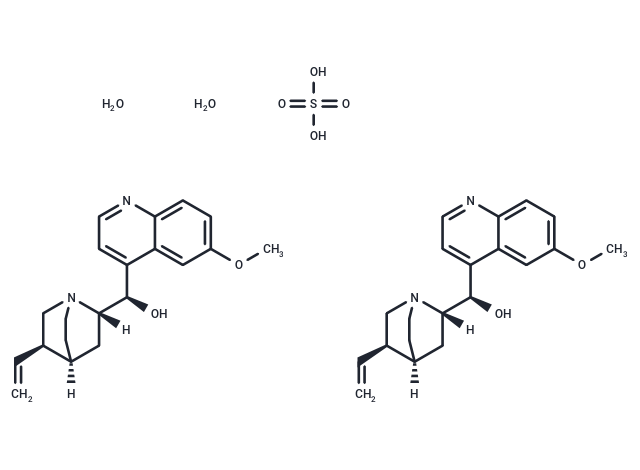
Quinine sulfate dihydrate
CAS No. 6119-70-6
Quinine sulfate dihydrate( —— )
Catalog No. M37775 CAS No. 6119-70-6
Quinine sulfate dihydrate plays a major role in potassium channel blockers. It is also used as an antimalarial, anticholinergic, antihypertensive and a hypoglycemic agent.
Purity : >98% (HPLC)
 COA
Datasheet
HNMR
HPLC
MSDS
Handing Instructions
COA
Datasheet
HNMR
HPLC
MSDS
Handing Instructions
| Size | Price / USD | Stock | Quantity |
| 500MG | Get Quote | In Stock |


|
| 1G | Get Quote | In Stock |
|
Biological Information
-
Product NameQuinine sulfate dihydrate
-
NoteResearch use only, not for human use.
-
Brief DescriptionQuinine sulfate dihydrate plays a major role in potassium channel blockers. It is also used as an antimalarial, anticholinergic, antihypertensive and a hypoglycemic agent.
-
DescriptionQuinine sulfate hydrate (2:1:4) is an orally active alkaloid extracted from cinchona bark and can be used in anti-malarial studies. Quinine sulfate hydrate (2:1:4) is a potassium channel inhibitor that inhibits WT mouse Slo3 (KCa5.1) channel currents evoked by voltage pulses to +100?mV with an IC50 of 169 μM.
-
In VitroQuinine sulfate hydrate (150 μM, 30 min) inhibits the proliferation and cytostatic effects of DENV (Dengue virus) in human hepatocarcinoma HepG2 cell line.Quinine sulfate hydrate (37.5-150 μM, 24 hours) significantly reduces viral DENV RNA and protein levels in a dose-dependent manner in human hepatocarcinoma HepG2 cell line.Cell Proliferation Assay Cell Line:Human hepatocarcinoma cell line(HepG2)Concentration:150 μM Incubation Time:30 min Result:Inhibited DENV virus replication with 19% yield compared to untreated. Reduced DENV-positive cells from 23.28% to 12.05% in a dose-dependent manner.
-
In VivoQuinine sulfate hydrate (oral gavage, 12 or 15 mg/kg, every week, 16 weeks) has some tumor suppressing effect on skin cancer in Swiss albino mice.Quinine sulfate hydrate (oral gavage, 10 mg/kg, everyday, 8 weeks) causes a decrease in the antioxidant defense system of rat testicular tissue such as SOD, CAT and GSH enzyme activity in male adult albino rats.Animal Model:Swiss albino mice 7-8-weeks (weighing 24 g) Dosage:12 mg/kg, 15 mg/kg Administration:Oral gavage; every week; 16 weeks Result:Resulted in a significant reduction in tumor size and weight at 12 mg/kg and little effect at higher dose of 15 mg/kg.
-
Synonyms——
-
PathwayCell Cycle/DNA Damage
-
TargetPotassium Channel
-
RecptorOthers | Potassium Channel
-
Research Area——
-
Indication——
Chemical Information
-
CAS Number6119-70-6
-
Formula Weight818.97
-
Molecular FormulaC40H58N4O12S
-
Purity>98% (HPLC)
-
Solubility——
-
SMILESO.O.OS(O)(=O)=O.[H][C@@]12CCN(C[C@@H]1C=C)[C@@]([H])(C2)[C@H](O)c1ccnc2ccc(OC)cc12.[H][C@@]12CCN(C[C@@H]1C=C)[C@@]([H])(C2)[C@H](O)c1ccnc2ccc(OC)cc12
-
Chemical Name——
Shipping & Storage Information
-
Storage(-20℃)
-
ShippingWith Ice Pack
-
Stability≥ 2 years
Reference
1. Shilu Malakar,et al. Drug repurposing of quinine as antiviral against dengue virus infection. Virus Res. 2018 Aug 15;255:171-178. doi: 10.1016/j.virusres.2018.07.018. Epub 2018 Jul 25.?
molnova catalog



related products
-
Methyl 4-hydroxycinn...
Methyl trans-p-Coumarat is a predicted metabolite generated by BioTransformer1 that is produced by the metabolism of methyl 3-phenylprop-2-enoate.
-
5-Hydroxydecanoate s...
5-Hydroxydecanoate sodium is a selective ATP-sensitive K+ (KATP) channel blocker with an IC50 of approximately 30 μM and a substrate for mitochondrial outer membrane acyl-CoA synthetase, possessing antioxidant properties.
-
NS8593 hydrochloride
NS8593 hydrochloride is a potent and selective inhibitor of small conductance Ca2+-activated K+ channels (SK channels) .
